The Haunting Chapel of Bones in Portugal
The Chapel of Bones in Portugal is one of the country’s most unusual attractions. Located in the historic city of Évora, this unique chapel draws thousands of visitors each year who come to see its walls decorated with human bones and skulls.
This guide tells you everything about the Chapel of Bones in Portugal—from its history and meaning to how you can experience it on our guided tours.
The Story Behind the Chapel of Bones in Portugal
The Chapel of Bones in Portugal began in the 16th century. Franciscan monks in Évora faced a common problem: the town’s cemeteries were becoming overcrowded. Instead of simply moving the bones elsewhere, they made an unusual decision.
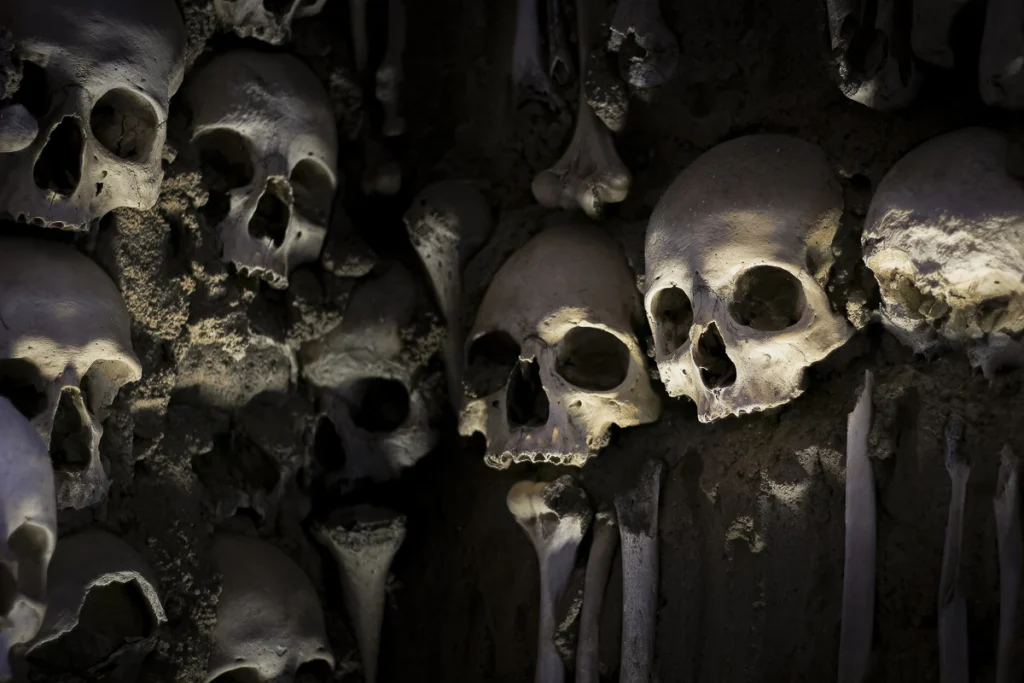
These monks gathered the bones and skulls of about 5,000 people from local burial grounds. They used these human remains to decorate the walls and ceiling of a new chapel connected to the Church of St. Francis (Igreja de São Francisco).
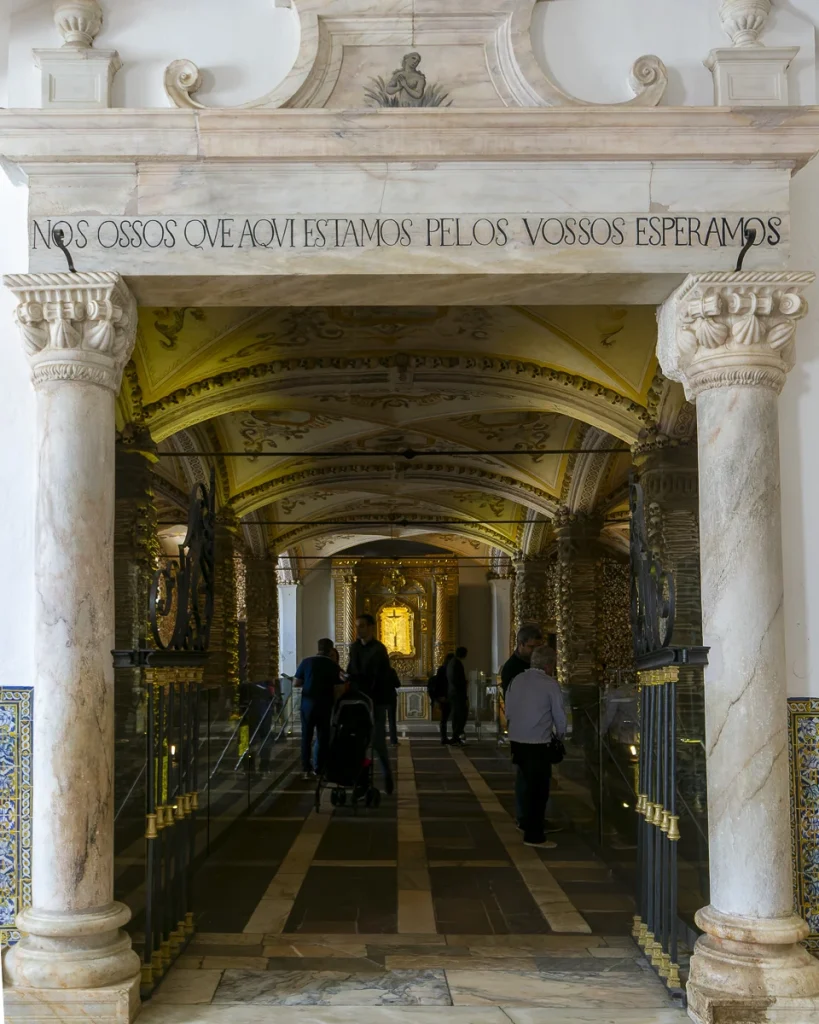
The monks weren’t trying to be scary or create a tourist spot. Their purpose was deeper: they wanted to deliver a powerful message about how short human life is. This message appears in the famous Portuguese inscription above the entrance: “Nós ossos que aqui estamos, pelos vossos esperamos” (“We bones that are here, await yours”).
Simply put, the monks wanted visitors to the Chapel of Bones in Portugal to remember that one day, they too would be nothing but bones. This was meant to encourage people to live good lives while they still could.
What You'll See Inside the Chapel of Bones in Portugal
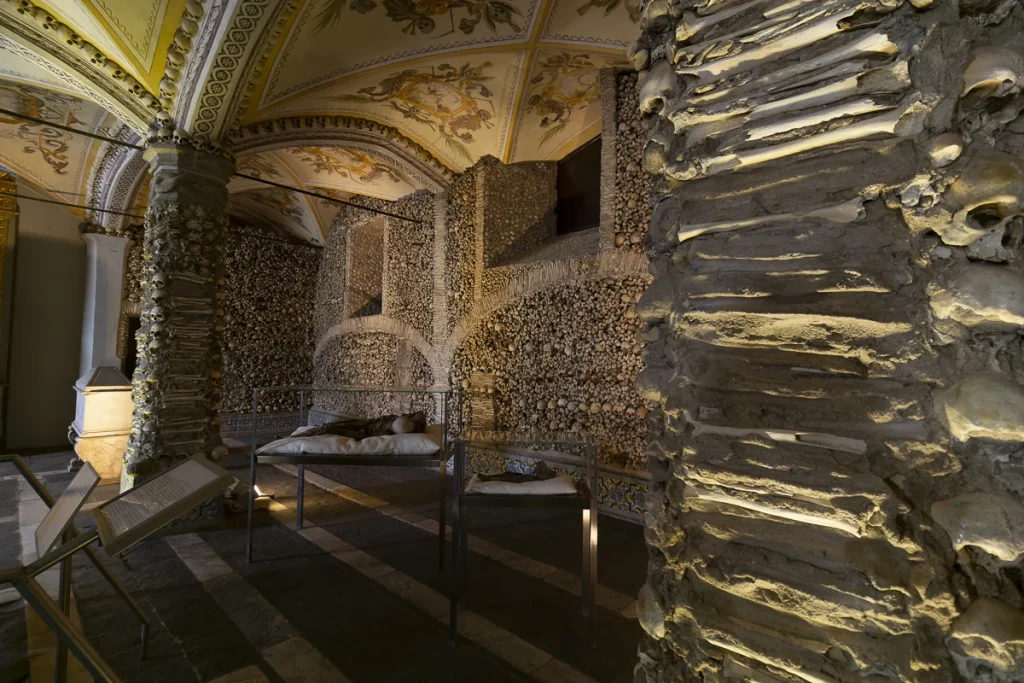
When you step into the Chapel of Bones in Portugal, you’ll find yourself in a rectangular room about 18.7 meters long by 11 meters wide. What makes this place truly unique is its decoration:
- Walls completely covered with bones and skulls arranged in patterns
- Ceiling decorated with bones in geometric designs
- Eight columns also adorned with human remains
- Two complete mummified bodies hanging from chains, including one of a child
Despite the unusual materials, there’s a surprising artistry to the Chapel of Bones in Portugal. The monks didn’t just pile bones randomly—they arranged them in careful patterns that show planning and design. Some bones form borders and decorative elements, while skulls are often placed at regular intervals to create visual rhythm.
One of the most striking features of the Chapel of Bones in Portugal is how the skulls seem to watch you from every direction. Some visitors find this unsettling, while others see it as a powerful reminder of our shared human fate.
Another interesting detail in the Chapel of Bones in Portugal is a white painted coffin near the altar that contains the remains of a child. According to local stories, this child was said to have been cursed for disrespecting his parents.
The Meaning Behind the Chapel of Bones in Portugal
The Chapel of Bones in Portugal represents more than a curiosity—it contains deep philosophical and religious meaning. The Franciscan monks who built it wanted to deliver an important message about life and death.
In the 16th century, many people thought differently about death than we do today. The Chapel of Bones in Portugal served as what’s called a “memento mori“—a reminder that everyone dies eventually. But this wasn’t meant to be depressing. Instead, it was supposed to help people:
- Live better lives while they still could
- Focus less on wealth and material things
- Think more about spiritual matters
- Prepare for what comes after death
Inside the Chapel of Bones in Portugal, another inscription reinforces this message: “Better to contemplate these things and think about our fate than to care about worldly things.” This philosophy encouraged visitors to focus on what really matters in life rather than chasing temporary pleasures or possessions.
This kind of deep thinking about mortality is similar to philosophical traditions found in other parts of Portugal, which you can explore on our Jewish Heritage of Lisbon tour that examines different cultural perspectives on life’s big questions.
Experience the Chapel of Bones in Portugal with Our Évora and Monsaraz Tour
Rather than trying to visit the Chapel of Bones in Portugal on your own, our Évora and Monsaraz Tour offers a complete experience with expert guides who bring the history and stories to life.
Our full-day tour includes:
- Professional guide who speaks English and knows all the fascinating stories about the Chapel of Bones in Portugal
- Comfortable transportation from Lisbon in our air-conditioned vehicle
- Skip-the-line access to the Chapel of Bones in Portugal and other attractions
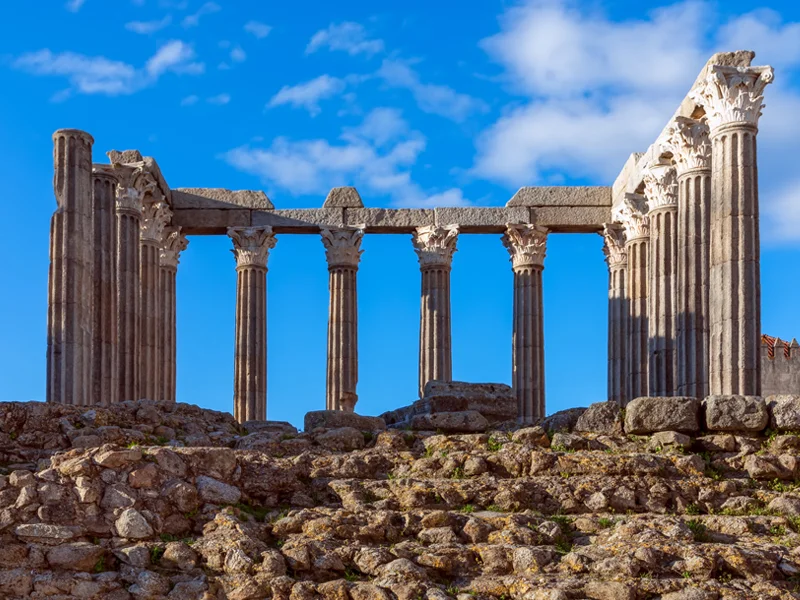
- Guided tour of Évora’s highlights including the Roman Temple and Cathedral
- Visit to the medieval village of Monsaraz with its stunning views
- Wine tasting at a local winery in the Alentejo region
- Small group size ensuring a personalized experience
The tour lasts approximately 8 hours, making it the perfect day trip from Lisbon to see the Chapel of Bones in Portugal and more.
Why Choose a Guided Tour of the Chapel of Bones in Portugal?
- Historical context: Our guides share stories and historical details you won’t find in guidebooks
- No logistical hassles: We handle all transportation, tickets, and timing
- Combined experiences: Visit multiple sites in one day without planning headaches
- Local knowledge: Discover the best places for authentic local food and souvenirs
- Photography tips: Learn the best angles and lighting for memorable photos of the Chapel of Bones in Portugal
Many visitors tell us that the stories and context provided by our guides transformed their understanding of the Chapel of Bones in Portugal from a simply curious attraction to a profound cultural experience. If you’re interested in exploring more of Portugal’s fascinating history, our Old Jewish Quarters Tour offers additional insights into the country’s rich cultural tapestry.
The City of Évora: Beyond the Chapel of Bones in Portugal
The Chapel of Bones in Portugal is just one of many historical treasures in Évora. This beautifully preserved medieval city offers numerous attractions worth exploring on our tour:
- Roman Temple of Évora (Temple of Diana): A well-preserved 1st-century Roman temple
- Évora Cathedral: A massive Gothic structure that offers rooftop views of the city
- University of Évora: One of the oldest universities in Portugal with beautiful historic buildings
- Água de Prata Aqueduct: A 16th-century aqueduct that stretches for miles
- Historic Center: Wander the narrow, winding streets filled with whitewashed houses
Évora is also known for its excellent regional Alentejo cuisine and nearby wineries, making it ideal for a day trip when visiting the Chapel of Bones in Portugal. Our tour includes opportunities to taste local specialties and wines that perfectly complement the cultural experiences.
For those interested in more wine-focused experiences in the same region as the Chapel of Bones in Portugal, our Alentejo Wine Tour offers a perfect complement to the cultural exploration of Évora.
Wine and History: The Perfect Combination Near the Chapel of Bones in Portugal
The region surrounding the Chapel of Bones in Portugal is also one of Portugal’s premier wine regions. After exploring the historical wonders of Évora, our Alentejo Wine Tour offers the perfect complement to your cultural journey.
This specialized tour takes you from Évora to:
- Vila de Frades: A charming village known for its traditional winemaking practices
- São Cucufate: A site with ancient Roman ruins and a long history of winemaking
- Local vineyards: Where you’ll learn about the unique growing conditions of the Alentejo region
This tour combines the rich history of the region with the opportunity to taste some of Portugal’s finest wines. Many visitors find that exploring both the Chapel of Bones in Portugal and the local wine traditions provides a perfect balance of cultural and culinary experiences.
The contrast between contemplating mortality at the Chapel of Bones in Portugal and then celebrating life through the region’s food and wine traditions creates a deeply meaningful travel experience.
Other Notable Bone Chapels in Portugal
While Évora’s Chapel of Bones in Portugal is the most famous, the country has several other bone chapels worth mentioning:
Capela dos Ossos in Faro
Located in the Carmo Church in the Algarve region, this smaller bone chapel contains the remains of more than 1,000 monks exhumed from the church’s cemetery. The bones were arranged on the walls in the 19th century. While less elaborate than Évora’s Chapel of Bones in Portugal, it still creates a powerful impression.
Capela dos Ossos in Alcantarilha
Another Algarve bone chapel, this small ossuary is part of the Igreja Matriz de Alcantarilha. The bones of approximately 1,500 people decorate the walls and ceiling in geometric patterns. What makes this chapel unique is its more remote location, resulting in fewer tourists than the Chapel of Bones in Portugal in Évora.
Campo Maior Bone Chapel
Located near the Spanish border, this ossuary contains the remains of people who died during a massive explosion in 1732. Unlike other bone chapels in Portugal, this one was created as a memorial to a specific tragic event.
These various bone chapels in Portugal demonstrate how widespread this tradition was in Portuguese religious culture, particularly as a way to contemplate mortality. Some of these sites can be explored on our specialized tours that venture beyond the main tourist areas.
The Jewish Connection to Évora and the Chapel of Bones in Portugal
While the Chapel of Bones in Portugal is a Christian monument, Évora also has a rich Jewish heritage worth exploring. Before the forced conversions of the 15th century, Évora had a thriving Jewish community with its own quarter.
Not far from the Chapel of Bones in Portugal, you can find traces of this Jewish heritage, including:
- The location of the former Jewish quarter
- Buildings with marks where mezuzahs once hung
- Sites associated with notable Sephardic Jews from Évora
Our Jewish Rural Heritage Tour explores these connections in depth, providing insight into the multicultural history of Portugal. The story of how different religious and cultural communities coexisted in medieval Portugal adds another dimension to understanding sites like the Chapel of Bones in Portugal.
For those interested in Portuguese historical figures who confronted profound moral questions, our article about Aristides Sousa Mendes explores the story of a diplomat who saved thousands of lives during World War II.
Visitor Experiences at the Chapel of Bones in Portugal
Visitors to the Chapel of Bones in Portugal often report powerful emotional responses:
“It wasn’t at all what I expected. Rather than being macabre, there was something peaceful and thought-provoking about the chapel. Our guide helped us understand the deeper meaning, which completely transformed the experience.” – Sarah from Canada
“The Chapel of Bones in Portugal was the highlight of our visit to Évora. The way the monks arranged the bones in patterns was both artistic and meaningful. It’s something you have to see to believe.” – Miguel from Spain
These testimonials highlight how important proper context and information are to fully appreciating the Chapel of Bones in Portugal, which is exactly what our guided tours provide.
Visiting the Chapel of Bones in Portugal: Practical Information
The Chapel of Bones in Portugal is located within the Church of St. Francis complex in Évora. While you could visit on your own, there are several reasons why joining our guided tour makes for a better experience:
- You’ll miss the meaning and stories behind the Chapel of Bones in Portugal without expert guidance
- Transportation from Lisbon to Évora takes about 1.5 hours each way
- Public transportation options are limited and time-consuming
- Renting a car adds stress and parking challenges
- Our tour combines the Chapel of Bones in Portugal with other must-see attractions in one convenient day
Our Évora and Monsaraz Tour is designed to give you the most comprehensive and hassle-free experience of the Chapel of Bones in Portugal and the surrounding region.
Photographs and Memories of the Chapel of Bones in Portugal
Photography is permitted inside the Chapel of Bones in Portugal, allowing you to capture this unique site. However, many visitors find that photos don’t fully convey the atmosphere and emotional impact of standing surrounded by thousands of human remains.
Our guides can suggest the best angles and lighting conditions for capturing meaningful images of the Chapel of Bones in Portugal. They’ll also help you understand the symbolic elements worth focusing on, creating photos that tell a deeper story.
Beyond photographs, the Chapel of Bones in Portugal often leaves visitors with lasting impressions and reflections on their own mortality. Many people report that this site affected them more profoundly than they expected, making it a highlight of their trip to Portugal.
Conclusion: Why Experience the Chapel of Bones in Portugal
The Chapel of Bones in Portugal offers more than just an unusual tourist attraction. This unique monument provides:
- A profound meditation on mortality that has resonated with visitors for centuries
- A glimpse into historical religious practices and philosophies
- Artistic appreciation for how something potentially gruesome was transformed into a meaningful aesthetic experience
- A truly unique photography opportunity unlike anywhere else in the world
- A different perspective on death that might change how you think about life
By joining our Évora and Monsaraz Tour, you’ll experience the Chapel of Bones in Portugal with expert guidance that brings its history and meaning to life. Combined with visits to Monsaraz village and a local winery, this tour offers a perfect day of exploration in the Alentejo region.
For wine enthusiasts, our Alentejo Wine Tour provides the perfect complement to your visit to the Chapel of Bones in Portugal, allowing you to experience both the rich history and culinary traditions of this remarkable region.
This extraordinary chapel reminds us that while life is temporary, the impact we make can last for centuries – a message as relevant today as it was when Franciscan monks first arranged these bones nearly 500 years ago.
Like the work of the historical figure Barros Basto, the Chapel of Bones in Portugal represents an important piece of Portuguese heritage that continues to inspire reflection and discussion to this day.